
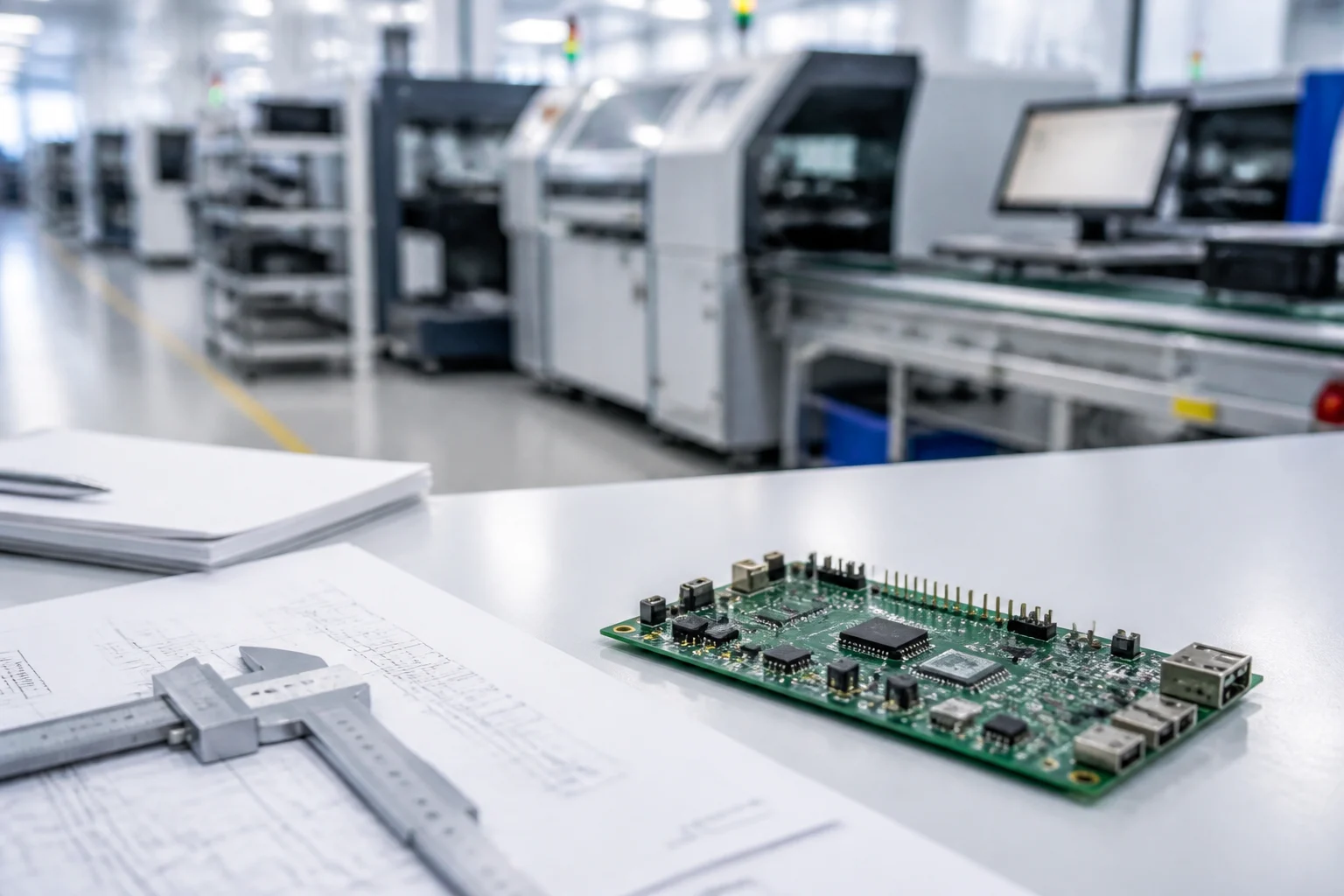
A prototype that works is an important milestone, but it is not proof that a PCB will remain stable in volume production. The transition from a sample build to repeated batches introduces more process variables: CAM preparation, material lots, drill and plating compensation, panel handling, inspection criteria, and production handover between shifts. A controlled production-transfer process turns those variables into documented decisions before they become yield problems.
Why a successful prototype does not guarantee stable production
Prototype orders are normally built with close engineering attention. The quantity is low, the production route can be adjusted quickly, and a small team may follow the job from CAM release through final inspection. When the same design moves into repeat production, consistency depends on whether the information learned during the first build is carried forward.
That is where avoidable risk appears. A board can pass functional testing in the sample stage while still having features that are sensitive to material variation, plating distribution, drill registration, routing, or assembly handling. None of these factors is unusual; the risk comes from leaving them undocumented.
| Prototype stage | Repeat-production stage |
|---|---|
| Small quantity with concentrated engineering attention | Multiple batches, shifts, material lots, and production schedules |
| CAM questions can be resolved case by case | Approved CAM decisions need to be retained and repeated |
| Inspection may focus on immediate sample issues | Inspection criteria need to protect long-term yield and reliability |
| One working build can validate basic functionality | Process stability has to be demonstrated across repeatable conditions |
The production-transfer details that matter most
Freeze the manufacturing intent, not only the Gerber files
A Gerber release is necessary, but it does not contain every manufacturing decision made during a prototype build. The approved production package should retain CAM notes, impedance requirements, stackup assumptions, special routing rules, critical-net information, panel requirements, and any customer-approved deviations. This gives each repeat batch the same starting point.
For designs near a process limit, it is especially important to record the finished requirement rather than relying on a nominal drawing value. Our guide to 0.20 mm PCB trace width and DFM tolerances explains why copper thickness, etching, and plating can influence the final result.
Lock material and stackup decisions early
Material substitutions can change more than price. Tg grade, resin system, copper foil type, dielectric thickness, and copper weight can affect impedance, thermal behavior, drill quality, and dimensional stability. When a design has controlled impedance, high layer counts, fine features, or demanding thermal performance, the approved stackup should be part of the repeat-order control plan.
Use the sample build to define inspection focus points
Sample-stage observations should become part of the production record. Typical focus points include annular ring margin, via fill or plating requirements, inner-layer registration, controlled-impedance coupons, solder-mask dam spacing, and cosmetic acceptance criteria. The objective is not to add inspection for its own sake; it is to inspect the failure modes that matter for that board.
For PCBA projects, the same principle applies after assembly. AOI, X-ray inspection, and flying probe testing answer different quality questions, so the test plan should follow the actual risk rather than a generic “100% tested” claim.
Control changes between batches
Good production control does not mean nothing can ever change. It means a change is visible, reviewed, and traceable. A clear change-control process should cover material availability, CAM revisions, tooling adjustments, panelization changes, process-route changes, and inspection updates. If a change affects a critical feature, the supplier and customer should decide whether a new first-article check is required before releasing volume.
A practical checklist before releasing a PCB to volume
- Confirm the approved stackup, copper weight, laminate grade, and finished-board requirements.
- Record CAM decisions and exceptions from the prototype build.
- Identify critical nets, impedance features, vias, drill sizes, and dimensional tolerances.
- Define the inspection and test methods that address the relevant failure modes.
- Set the engineering change and material-substitution approval route.
- Keep lot and production records traceable for repeat orders.
- Review feedback from the first assembly run before increasing volume.
What buyers should ask before a repeat order
Before moving from a working sample to a larger order, ask your PCB supplier: What has been frozen from the prototype build? Which material and process parameters are controlled? What will trigger a new engineering review? Which test methods cover our highest-risk features? The answers reveal more about future reliability than a quotation alone.
Price comparisons should also be read in the context of those assumptions. Two suppliers can quote the same Gerber file differently because they are allowing for different laminate, copper, via, impedance, testing, and yield requirements. See why PCB quotes for the same Gerber file can differ.
Build for repeatability from the first prototype
The best time to protect production consistency is before the first board is built. A disciplined handover from prototype to repeat production helps prevent late engineering changes, unstable yield, and time-consuming debugging at assembly. Cheerise Circuits supports prototype-to-production PCB programs with DFM communication, documented manufacturing controls, and inspection plans aligned to the design risk.
Contact Cheerise Circuits to discuss a repeat-order or production-transfer requirement.
Frequently asked questions
Why can a PCB prototype pass but a production batch have yield problems?
Prototype builds receive concentrated attention and may use a tightly controlled production path. In repeat production, material lots, shifts, tooling, CAM handling, and inspection execution must all remain consistent. Undocumented prototype-stage decisions can therefore become batch variation later.
What should be included in a PCB production-transfer package?
It should include the approved Gerber and drill data, stackup, material requirements, CAM notes, impedance requirements, critical features, panelization rules, inspection focus points, test requirements, and change-control instructions.
When should a PCB supplier perform another first-article check?
A first-article review is appropriate when a material, stackup, CAM decision, process route, critical tooling, or design revision changes in a way that could affect a key electrical, mechanical, or reliability requirement.