
PCB surface finish is often treated as a technical detail to be finalized after the board design. For OEM and EMS buyers, that decision also influences assembly, storage, inspection and potential rework.
Choosing the most expensive finish does not automatically make a PCB more reliable. Choosing the lowest-cost finish without considering downstream handling can be equally problematic. The useful question is: Which finish supports the complete production and logistics plan for this design?
What a PCB surface finish actually does
A surface finish protects exposed copper features and provides an appropriate surface for soldering or contact, depending on the application. It does not replace pad design, process control or qualification.
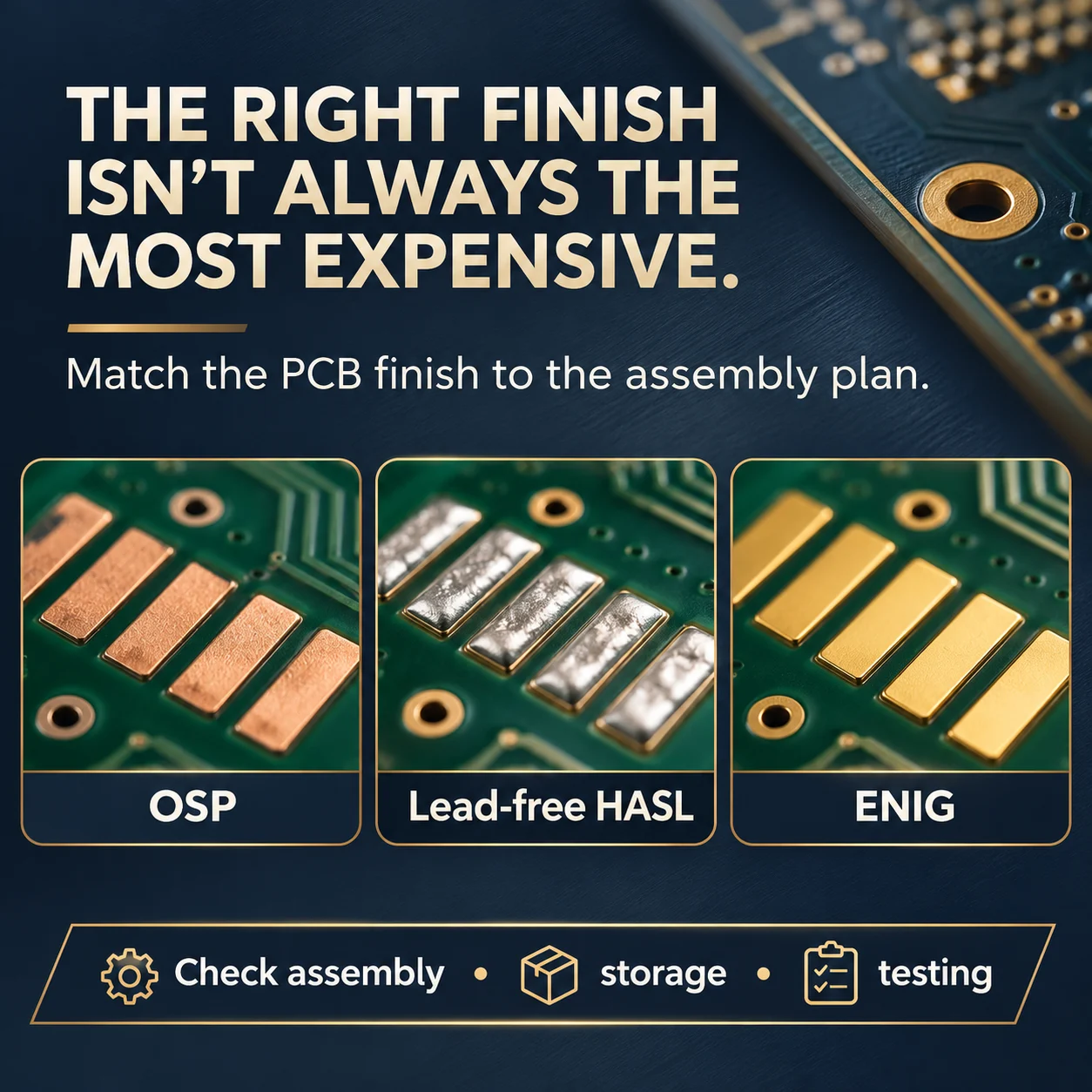
For many standard rigid PCB projects, OSP, lead-free HASL and ENIG are familiar choices. Other finishes can suit specialized applications. Price alone is not a selection method.
OSP: flat pads, with greater attention to handling
Organic Solderability Preservative (OSP) forms a thin protective film on exposed copper. It provides a flat surface and can be economical for suitable manufacturing programs. However, the handling and storage plan matters. Discuss packaging, humidity and assembly sequence with the EMS partner.
OSP can be a good fit when the assembly process and material flow are well controlled. It should not be selected only because it appears cheaper on a PCB quote; multiple thermal excursions, delayed assembly or heavy rework may change the assessment. Agree on the process window with the fabricator and assembler. Obtain supplier-specific storage limits and packaging instructions; do not assume a universal shelf life or permitted number of reflow cycles.
Lead-free HASL: practical, but not equally flat
Lead-free Hot Air Solder Levelling (HASL) coats exposed pads with solder and removes excess solder with hot air. It can suit conventional designs that tolerate variation in solder height.
The qualification issue is pad planarity. Fine-pitch devices, particularly some area-array packages, can require more consistent pad surfaces than HASL provides. The hot solder process also exposes the board to thermal stress. The PCB supplier should confirm whether the board structure and planned component assembly make this finish appropriate.
ENIG: flat and versatile, not risk-free
Electroless Nickel Immersion Gold (ENIG) creates a nickel barrier covered by a thin gold layer. It produces flat pads and can be attractive for fine-pitch assembly or projects needing a more flexible handling and storage window. It typically carries a higher fabrication cost than simpler finish choices.
ENIG is not a universal reliability upgrade. Plating quality and acceptance criteria still matter. A product with repeatedly mated contacts, for example, may require a separate contact-finish discussion rather than assuming standard ENIG is suitable for the wear conditions.
Procurement checklist before releasing the RFQ
Use this cross-functional review before locking the finish on the fabrication drawing:
- Component geometry: Identify the finest assembly pitch, relevant BGA or QFN pads and any unusual contact requirements.
- Assembly sequence: Confirm single- or double-sided processes, planned soldering steps and the realistic possibility of rework.
- Storage and logistics: Estimate the time from bare-board receipt to assembly, including transport and potential inventory holding.
- Inspection and contact: Clarify probe-contact requirements, exposed test points and any connectors requiring repeated engagement.
- Acceptance criteria: Agree on the finish, applicable specification, inspection evidence and any customer-specific requirements.
- Total project cost: Compare fabrication pricing against credible handling, yield, scheduling and rework implications rather than assuming one finish will always be cheaper.
The PCB designer, EMS process engineer, quality team and purchasing owner should agree before procurement freezes the order. Where finish changes are proposed after qualification, assess them through the project's normal engineering approval and change-control process.
Matching the finish to the actual build
For a straightforward industrial control PCB with larger pads and ordinary assembly conditions, lead-free HASL may deserve consideration. For a fine-pitch assembly, ENIG or another suitably qualified flat finish may be more appropriate. In a cost-sensitive, tightly managed high-volume process, OSP may be a strong candidate.
These are screening examples, not production approvals. Board geometry, application requirements, assembly equipment, packaging and manufacturing capability must be assessed for the actual project.
Cheerise Circuits lists several surface-finish options in its manufacturing and assembly services information. Buyers preparing a project can review the PCB manufacturing FAQ for RFQ inputs and the PCB assembly services page for production coordination. Final finish selection requires engineering review.
Frequently asked questions
Is ENIG always better than OSP?
No. ENIG and OSP have different cost, handling and processing characteristics. The correct choice depends on the design and the entire assembly flow. Neither should be specified by habit alone.
Can lead-free HASL be used for a fine-pitch PCB?
Its less-uniform pad surface can make it unsuitable for some fine-pitch or area-array applications. Ask the PCB fabricator and assembler to review the actual pad geometry before selecting it.
Should purchasing change the surface finish to reduce cost?
Not without engineering and assembly approval. A finish substitution can affect soldering, inspection, storage and qualification. Record the proposed change, its rationale and the approval decision before updating the manufacturing specification.
The best surface finish is the one that has been verified against the whole build—not simply the cheapest line on the quote.