
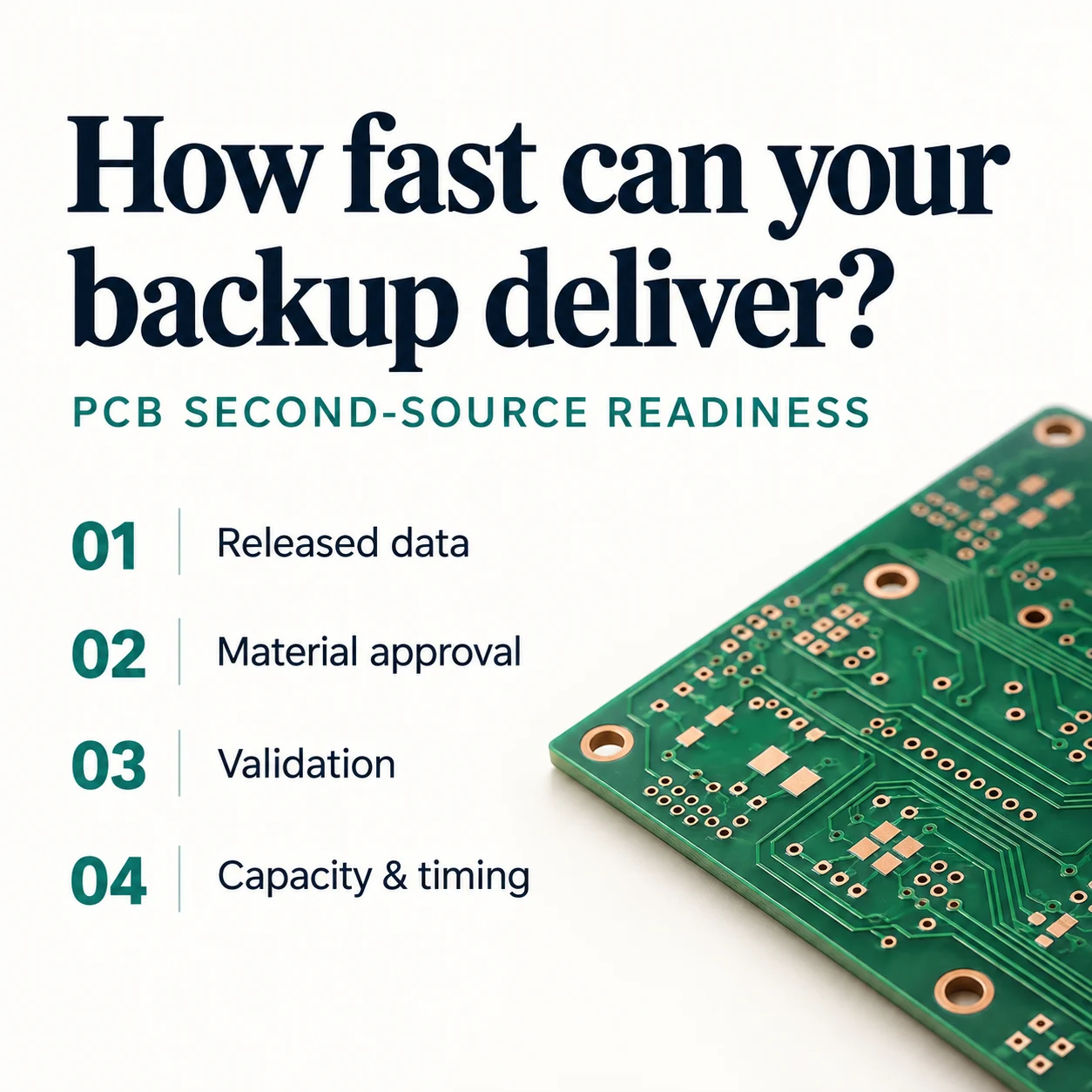
A backup PCB supplier is useful when it can deliver an approved production lot that your team can actually use. For an OEM or EMS buyer, the practical measure is the time from a supply disruption to boards entering assembly—not simply the number of suppliers on an approved list.
That timeline can include engineering questions, material approval, a trial build, customer sign-off, fabrication and freight. A second-source plan becomes more useful when those steps are visible before an urgent order arrives.
What does PCB second-source readiness mean?
Second-source readiness means knowing what remains between a potential supplier and the next usable production lot. Commercial onboarding is one part of the process. The board-specific manufacturing requirements, acceptance evidence and delivery arrangements also need to be agreed.
A supplier may have suitable equipment and a competitive quotation while still waiting for a material decision or a design clarification. Those open items belong in the sourcing plan because they can affect when production can begin.
Four checks before relying on a backup PCB supplier
1. Release a complete, controlled data package
Confirm the design revision, Gerber or other agreed manufacturing data, drill files, fabrication drawing and stack-up. Include the finished-board requirements and any critical features that need specific attention.
Resolve engineering questions and record approved deviations. The replacement supplier should work from an agreed release, with a clear route for approving any subsequent changes.
2. Define the material approval route
State the required laminate and construction. If alternatives are permitted, identify who must approve them and what evidence that decision requires.
A proposed substitute should be reviewed against the design and application requirements by the responsible engineering team. Procurement can coordinate availability, but availability alone does not establish technical suitability. Confirm any required customer approval before making the change.
3. Agree on acceptance evidence
Define the inspection and electrical test requirements, relevant reports and any application-specific validation. Decide whether a trial build or first-article review is required and who releases the result for production.
Bare-board electrical testing and final application validation answer different questions. A passed sample provides useful evidence, but it does not remove every approval step or prove that every future production condition will be identical. Our guide to what PCB electrical testing covers explains the distinction.
4. Build an activation plan
Review current material availability, manufacturing capacity, order quantity and delivery timing. Clarify the conditions behind the quoted lead time, including when the clock starts and which approvals must already be complete.
Include shipping and receiving in the plan. A board leaving the factory is a different milestone from an accepted lot becoming available to the assembly team. Recheck material and capacity assumptions when the backup source is needed.
A practical checklist for procurement teams
| Readiness area | Evidence to confirm |
|---|---|
| Released data | Correct revision, agreed stack-up and resolved engineering questions. |
| Material approval | Specified laminate, permitted alternatives and named approval owners. |
| Acceptance evidence | Agreed inspection, test and validation requirements; open approvals recorded. |
| Activation plan | Material and capacity checks, order quantity and delivery milestones. |
For each open item, record an owner, the next action and a realistic completion date. Review the plan when the design, material availability or production needs change.
Measure the time to the next usable lot
The useful sourcing question is: What remains between this supplier and our next usable production lot?
This turns a supplier-list entry into a practical conversation about engineering, quality and delivery. It also helps procurement teams see which preparation can be completed now and which assumptions need to be checked again at activation.
For related preparation, read our guide to moving from prototype approval to stable PCB production. To discuss a PCB second-source requirement, contact Cheerise Circuits with your released manufacturing data, required quantity and target delivery date.
Frequently asked questions
Does an approved supplier list prove PCB second-source readiness?
No. Supplier approval and readiness for a particular board are separate checks. Confirm the released data, materials, acceptance evidence and activation arrangements for the actual program.
Does a passed sample reserve future production capacity?
No. Sample acceptance provides evidence for that build. Future material availability, capacity and delivery timing still need to be confirmed.
How long should PCB second-source qualification take?
There is no single duration for every project. The timeline depends on the board requirements, material decisions, required builds, validation and approval process. Plan the open steps instead of assuming a fixed number of days.